
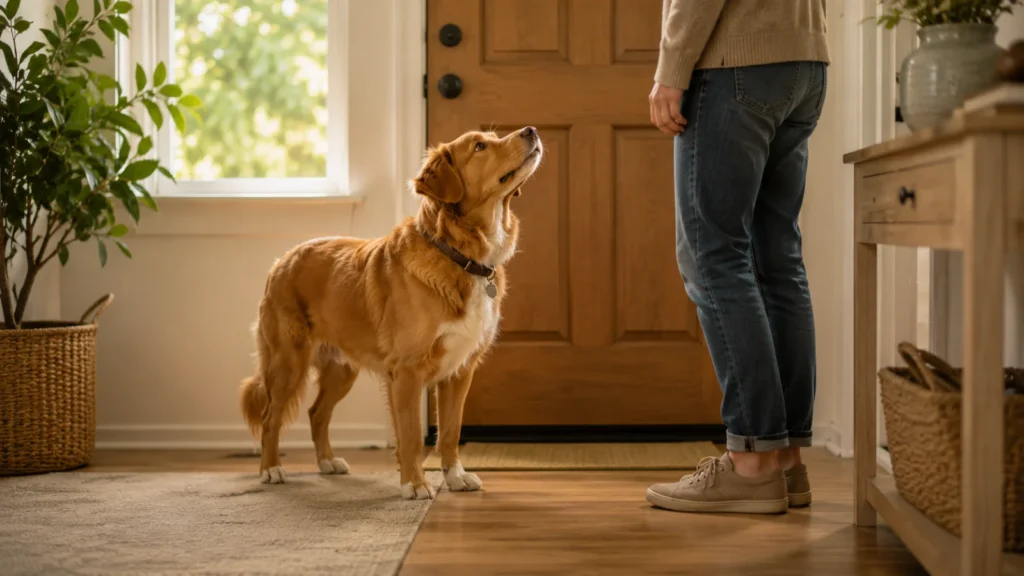
The front door opens, and your dog loses every ounce of composure they had five seconds ago. Jumping, spinning, launching themselves at whoever just walked in. You’re apologizing before the guest even gets their shoes off. You’ve said “no,” you’ve pushed them down, you’ve tried holding their collar. Nothing sticks. And the embarrassment every single time someone visits is starting to make you dread having people over at all.
What most owners don’t realize is that the instinct to correct jumping often makes the cycle harder to break, not easier. This article explains why that happens, and what actually works when your dog is jumping on guests.
Why Dog Jumping on Guests Happens in the First Place
For many dogs, jumping becomes part of the greeting routine. It gets them closer to people and, just as importantly, it gets a reaction. Voices go up, hands come out, eye contact happens. Even being pushed away involves touch and attention.
From your dog’s perspective, jumping has been working beautifully for a long time. The behavior stuck around because it got reinforced, not because your dog is dominant, badly behaved, or trying to embarrass you in front of your mother-in-law. This matters because how you understand the behavior shapes what you do about it.
In many cases like this, the issue is not disobedience. It is overstimulation combined with a well-rehearsed habit. A guest arriving is one of the most exciting events in a social dog’s day. The arousal spikes fast, and the default behavior kicks in before any trained response has a chance to surface.
Why Saying ‘No’ Can Make it Worse
When your dog jumps and you say “no,” push them off, or knee them in the chest, something important happens: your dog gets feedback, but not the feedback you think you’re sending.
For a dog seeking interaction, even negative attention can keep the jumping cycle going. The dog is already in an excited state. You engaging with them, physically or verbally, often reads as participation. You’re in it. The game continues.
More importantly, saying “no” tells your dog what not to do. It does not tell them what to do instead. Dogs don’t generalize instructions the way people do. “No jumping” doesn’t automatically become “stand calmly and wait.” That alternative behavior has to be taught separately, practiced repeatedly, and reinforced clearly, especially in the specific context of someone walking through the door.
The corrections most owners use are reactive. They happen after the jump. At that point, the behavior has already occurred and in many cases already been rewarded by the contact itself. Consistency before the jump, not correction after it, is where the real work happens.
What You’re Teaching Instead (And Why It Matters)
The goal is not to eliminate your dog’s excitement about guests. That excitement is part of what makes dogs wonderful. The goal is to give that excitement somewhere productive to land.
Four-on-the-floor is the most common alternative behavior trained for door greetings. The rule is straightforward: any time all four paws are on the ground, something good happens. Any time they leave the ground, everything good disappears. No drama, no scolding, no eye contact. Just a calm, total removal of anything the dog finds rewarding, followed immediately by calm re-engagement the moment they settle.
This works because it’s clear. The dog learns, through repetition, that paws down is the path to everything they want: attention, treats, the guest’s energy, all of it. Paws up gets them nothing. With repetition, the contrast becomes clear: paws on the floor makes attention happen; jumping makes attention pause.
This is the foundation of what the ASPCA and positive reinforcement trainers recommend broadly: reinforce the behavior you want, remove reinforcement from the behavior you don’t, and be consistent enough that the pattern becomes obvious to the dog.
The 5-Step Calm Greeting Practice
Consistency is the whole game here, and that starts with setting the environment up before the door opens.
Step 1: Manage the moment. Use a PAWLAND Wooden Freestanding Foldable Pet Gate or leash to control the greeting space while your dog is still learning. You cannot train effectively in pure chaos. A barrier buys you the half-second you need to redirect.
Step 2: Ask for something your dog already knows. “Sit” is enough. Ask for it before the door opens, not after the jumping starts. If your dog can hold a sit while you open the door, even for two seconds, reinforce that immediately and heavily.
Step 3: Train the guests. This is where most owners lose momentum. You do everything right, and then your guest walks in and gives your dog exactly what they were jumping for. Brief your guests before they arrive. One sentence: “Please ignore him completely until all four paws are on the floor, then say hi.” Most guests are happy to help when they know what you’re working on.
Step 4: Reward low-arousal behavior at the door. Keep high-value treats near the door. The moment your dog makes contact with the floor after a jump, or better, never leaves it, that treat should arrive fast. Timing matters more than the treat itself.
Step 5: Practice without guests present. Stage mock arrivals. Walk in and out yourself. Have a family member knock. Ring the doorbell. Practice the routine until your dog starts anticipating calmness at the door rather than chaos. Repetition in a low-stakes context is what makes the behavior available when stakes are high.
Every dog’s situation is a little different. If your dog’s jumping feels impossible to manage even with these steps, get your dog’s personalized breakdown to find out what’s really driving it.

When the Jumping Feels Out of Control
Some dogs jump with an intensity that goes beyond excitement. Scratching. Spinning. Vocalizing. Some can’t settle even minutes after someone arrives. That’s different from a dog who simply gets overly excited. When a dog genuinely struggles to settle, the jumping can be part of a broader arousal or anxiety pattern, not just a training gap.
If your dog remains highly distressed or unable to settle around visitors, the issue may extend beyond the greeting itself. A qualified behavior professional, or a veterinary behaviorist for more severe cases, can help identify what’s driving the response and build a plan around it. If the behavior appeared suddenly or comes with other unusual changes, loop in your regular vet too, to rule out anything medical. Getting professional support is not a sign that you’ve failed. It’s one of the most effective things you can do for your dog.
Behavior problems rooted in anxiety generally respond better when addressed early, before patterns become deeply ingrained, according to organizations like the American Veterinary Society of Animal Behavior. That’s not alarmist. It’s just practical.
If this sounds like your dog, don’t keep cycling through the same corrections and hoping something clicks.
Why It’s Worth Working on Early
Jumping on guests tends to escalate in a predictable direction. A puppy jumping is cute to most people. A 40-pound adolescent dog jumping is startling. An adult dog of any size launching at an elderly guest, a child, or someone with a fear of dogs becomes a genuine safety concern, even when the dog’s intentions are completely friendly.
Beyond the physical risk, the behavioral pattern often broadens over time. Dogs that don’t learn to regulate their arousal at the door can develop difficulty managing excitement in other high-stimulation situations. Leash encounters, car arrivals, children running. The door is where many dogs first show that their excitement threshold is set too high, and it’s the best place to address it.
Owners who delay working on this often find themselves limiting their social lives, avoiding having people over, or managing their dog by isolation during visits. That’s a real quality-of-life cost for both the dog and the household. You can read more about how early behavior patterns connect over time on the PrimeDoggy blog.
The door behavior your dog has now is trainable. It does take time and consistency, and the right approach matters more than most people realize.
If you’ve read through this and still feel like you’re guessing at what your dog specifically needs, that’s a common place to land. Generic advice about dog jumping on guests covers the pattern. It doesn’t account for your dog’s arousal level, their history, how long the behavior has been practiced, or what’s actually driving the excitement.
The PrimeDoggy Dog Wellness Profile is built for exactly that gap. It takes the information you share about your dog’s specific behavior, environment, and routine, and returns a personalized plan grounded in the Calm Dog Method. Used by dog owners working to build calmer routines every day, it’s the clearest starting point for knowing what to actually work on first, in the right order, for your dog.
Start your dog’s calm plan here, free, instant, and built around your specific situation: Get Your Dog’s Personalized Calm Plan
Raising a puppy or working through early training struggles? Get the step-by-step guide → The Complete Puppy Training Guide (also available in paperback on Amazon)
As an Amazon Associate, PrimeDoggy may earn from qualifying purchases.