
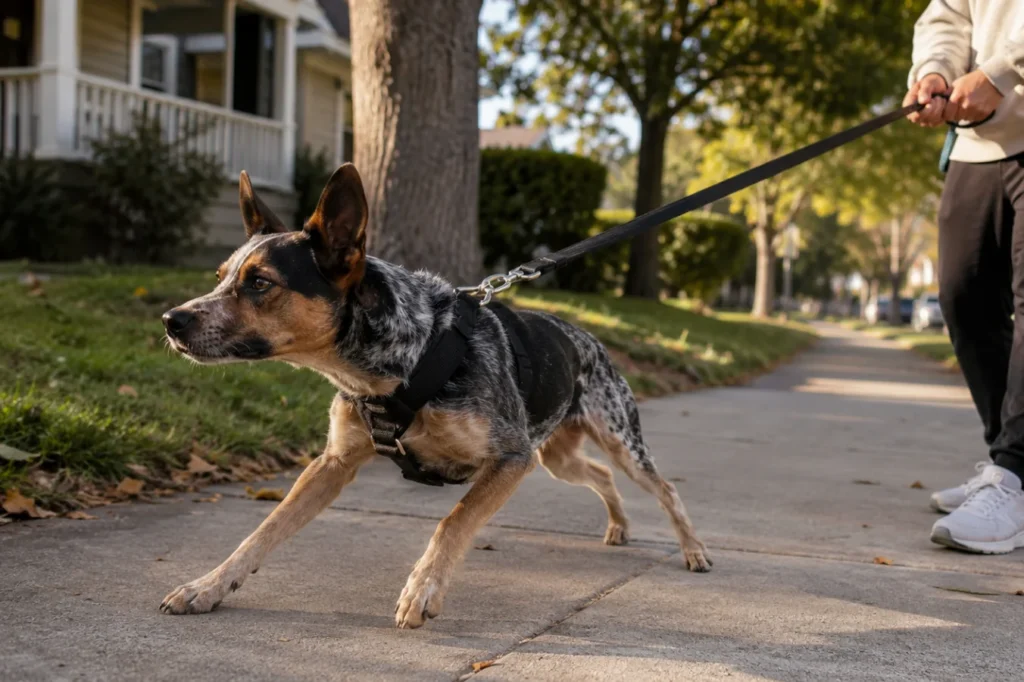
Is your dog dangerous, or just overwhelmed? That question sits in the back of a lot of owners’ minds after the walk goes sideways and a stranger shoots you a look. When your dog lunges at other dogs, the world around you tends to make up its mind fast. The label “aggressive” gets thrown around before anyone stops to ask what your dog was actually trying to communicate.
Lunging and barking on leash do not automatically mean a dog is dangerous. These behaviors are often described as reactivity, and reactivity is not the same thing as aggression, although the two can overlap. Understanding the difference is where real progress starts, because the approach that works for one will not work for the other, and misreading your dog’s behavior can make things worse, not better.
This post is about what reactivity actually looks like, why it happens, and what your dog’s lunging is most likely trying to tell you.
Reactivity and Aggression: Why the Distinction Matters
Aggression and reactivity can look identical from across the street. Both involve barking, lunging, and a dog that suddenly seems impossible to manage. The difference lives in the motivation behind the behavior, and understanding that motivation changes everything about how you respond.
Aggression describes behaviors such as threatening displays, growling, snapping, or biting, while reactivity describes an unusually intense response to a trigger. The two can overlap, but they are not interchangeable. Reactivity may be driven by fear, frustration, excitement, or overstimulation, and many reactive dogs are trying to create distance rather than move closer. The display is loud and dramatic precisely because it works: the other dog usually moves away, and the reactive dog learns that the explosion got them what they needed.
Think about the dog who loses it at the end of the leash, then the moment the other dog is gone, shakes it off and sniffs a bush like nothing happened. That rapid return to baseline can be an important clue that the reaction is closely tied to a specific trigger. It does not tell you everything about the dog or eliminate the possibility of aggressive behavior, but it helps build a clearer picture of what is happening.
This distinction matters because the reason behind a behavior should shape how it is addressed. Assuming every reactive display means a dog is broadly aggressive can lead to responses that increase fear or stress. At the same time, dismissing growling, snapping, biting, or other concerning behavior as “just reactivity” can underestimate genuine safety risks and delay the professional help a dog may need.
Why A Dog Lunges at Other Dogs on Leash
The leash itself is part of the problem. Off-leash, most dogs who struggle on walks can read and respond to other dogs using normal canine body language: they approach at an angle, sniff, circle, or simply move away if they’re uncomfortable. The leash removes that option entirely.
When a dog cannot move freely, the leash can limit important coping strategies such as increasing distance, changing direction, or approaching more gradually. For some dogs, that restriction can increase frustration or fear. Then the trigger appears, another dog trotting toward them on the sidewalk, and there is nowhere to go. Some dogs respond by escalating into barking, pulling, or lunging. The reaction can be loud, physical, and impossible to ignore.
Barrier frustration is one of the most common reasons a dog will lunge at other dogs, and it affects dogs who would actually love to meet that other dog just as much as dogs who want no part of the interaction. Both ends of that spectrum can produce the same explosive display on leash.
Fear is the other major driver. Some dogs are not frustrated at all. They are genuinely scared of other dogs, and lunging is their way of trying to push the threat farther away. These dogs may show signs of tension before the reaction, such as a stiff posture, changes in ear or tail position, raised hackles, avoidance, or weight shifting away from the trigger even as they eventually lunge forward. Reading that body language early is one of the most useful skills a reactive dog’s owner can develop.
5 Signs Your Dog’s Lunging May Be Reactivity
Every dog is different, and no checklist can determine why a dog is lunging or rule out a safety concern. But these patterns can offer useful clues that your dog’s response is strongly tied to a specific trigger, emotional state, or situation.
1. They calm down quickly after the trigger disappears. Some reactive dogs recover relatively quickly once enough distance opens up between them and the trigger. They may return to sniffing, exploring, or walking normally soon afterward. Recovery time is useful information, but it should be considered alongside the rest of the dog’s behavior and history.
2. The reaction appears to create distance. Many dogs react because they want more space from something that worries or overwhelms them. Even a dog lunging forward may be attempting to make the trigger move away. Because motivation cannot be determined from lunging alone, the dog’s full body language, history, and context matter.
3. The behavior is consistent and predictable. Reactive dogs usually have clear triggers: other dogs at a certain distance, dogs behind fences, dogs that move quickly toward them. The reaction follows a pattern you can learn to anticipate.
4. The behavior may be highly context-specific. A reactive dog may be perfectly relaxed at home or around familiar people, then struggle intensely when a particular trigger appears on leash. Aggressive behavior can also be context-specific, however, so being relaxed in other situations does not by itself rule out a safety concern.
5. Frustration may be visible before the reaction. Some reactive dogs whine, pull, bounce, or become increasingly excited before barking or lunging. In some dogs, that pattern can point toward frustration around being unable to approach or interact, although excitement and frustration can coexist with stress or uncertainty.
If this sounds like your dog, getting a clearer picture of what’s driving the behavior is the most useful next step you can take. Get Your Dog’s Personalized Behavior Breakdown and find out what your dog’s reactivity profile actually looks like.
What Your Dog Is Actually Trying to Tell You
A dog who lunges and barks is communicating. The display is not random, even if it feels that way in the moment. Reactive behavior can have different drivers. A dog may effectively be communicating: I need more distance from that, I am frustrated I cannot get to that, or I cannot handle this much stimulation right now.
Understanding which message your dog is sending changes how you respond. A fearful dog generally needs enough distance from the trigger to remain able to learn, rather than being pushed closer simply to “get used to it.” Forcing prolonged exposure at an intensity the dog cannot comfortably handle can increase fear and make future reactions harder to manage. The American Veterinary Society of Animal Behavior recommends humane, reward-based approaches to behavior modification and cautions against methods that rely on fear, pain, or intimidation.
When frustration appears to be a major part of the reaction, training can focus on helping the dog stay under threshold, disengage from the trigger, and learn that calmer behavior produces good outcomes. Some of these dogs may have strong social interest but struggle to manage their arousal when access to another dog is restricted.
Both require patience. Both require consistency. And both tend to get lumped into the same unhelpful category of “aggressive dog” when what they actually need is someone willing to look closer.
The Role Equipment Plays (and What It Cannot Do)
A well-fitted front-clip harness can be useful when managing a dog who lunges on leash. Compared with equipment that allows a dog to drive straight forward, a front attachment can help reduce pulling leverage and give the handler more control while creating distance from a trigger. Options such as the Rabbitgoo no pull dog harness can serve this management role, provided the harness fits properly and allows comfortable movement.
This kind of equipment can make walks safer and more manageable while you work on the underlying behavior. It is a genuine tool, not a quick fix. The reactivity does not disappear when you change the harness. But having better physical control can make it easier to create distance during a trigger moment, and distance is one of the most useful variables an owner can manage during reactive encounters.
Equipment supports training. It does not replace it. What changes reactive behavior is consistent work on the emotional response underneath the explosion, usually with the guidance of someone who understands how to set up the right scenarios at the right distances for your specific dog. For a deeper look at what that training process actually involves, the ASPCA offers solid foundational guidance on fear and anxiety in dogs that is worth reading alongside any training approach you take.

When to Bring in a Professional
Reactivity is common. It is also one of the behavior patterns where working with a certified trainer makes the biggest difference, especially early on. The reason is not that owners cannot handle it alone. It is that the mechanics of desensitization and counter-conditioning are genuinely easier to get right with someone watching in real time.
A certified trainer who specializes in fear and reactivity can assess where your dog’s threshold is, design a systematic exposure plan, and help you read the body language signals that tell you whether you are making progress or pushing too fast. Look for a qualified professional with relevant experience in fear, reactivity, and humane behavior modification. Organizations such as the International Association of Animal Behavior Consultants and the Certification Council for Professional Dog Trainers provide directories that can help owners find credentialed professionals.
If your dog has snapped, bitten, made contact during a reaction, or is showing escalating or difficult-to-manage behavior, professional assessment should move higher on the priority list. A veterinarian can also help rule out medical contributors and, when appropriate, refer you to a veterinary behaviorist for more complex cases. Some reactive dogs also have underlying anxiety or medical factors that warrant veterinary assessment. When medication or other veterinary support is appropriate, it can be used alongside a behavior-modification plan rather than as a replacement for one.
You can also read through more dog behavior articles on the PrimeDoggy blog to build a stronger foundation before your first session.
Recommended Next Step
If you have been searching for answers about why your dog lunges at other dogs, you have probably read a lot of general advice that does not quite fit your situation. That is the core problem with generic reactivity content: it describes the pattern without knowing anything about your specific dog, what triggers them, how intense the reaction is, what their baseline anxiety looks like, or what has already been tried.
The PrimeDoggy Dog Wellness Profile was built for exactly this gap. It considers details about your dog, their environment, triggers, behavior patterns, and what you have already tried to generate a personalized breakdown of factors that may be contributing to the behavior and areas worth focusing on first. It is not a generic quiz attached to an article. It is designed to give you a more structured starting point based on your individual dog.
Start your dog’s calm plan here, free, instant, and built around your dog specifically: Take the Dog Wellness Profile.
Raising a puppy or working through early training struggles? Get the step-by-step guide → The Complete Puppy Training Guide (also available in paperback on Amazon)
As an Amazon Associate, PrimeDoggy may earn from qualifying purchases.