
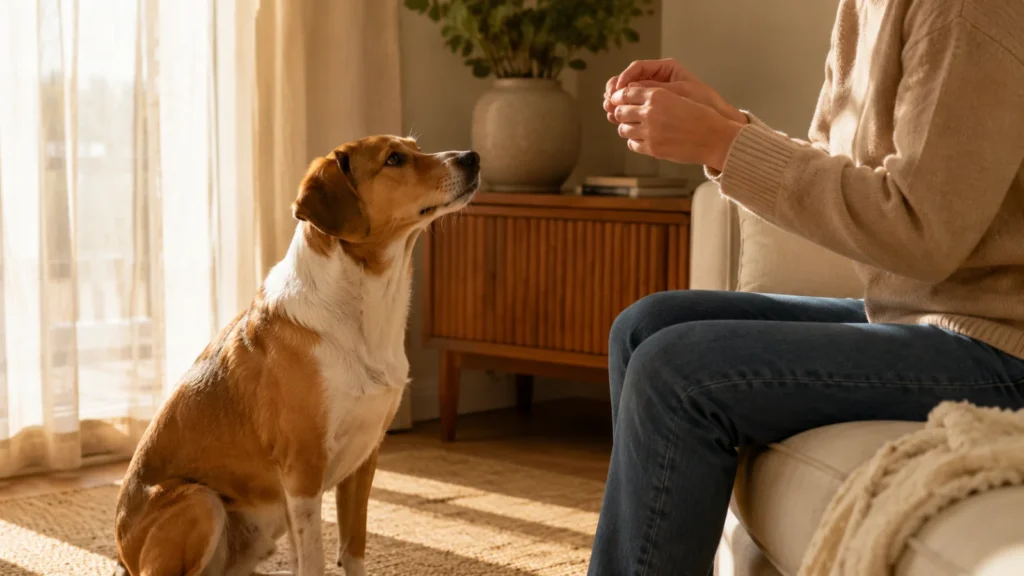
Saying “sit” four times before your dog actually sits feels like a patience problem. Most people assume the fix is more repetition, more volume, or more firmness. That assumption is exactly what keeps the pattern going.
When a dog ignores commands until the third or fourth repetition, the frustrating truth is that the dog has learned to wait. Not out of stubbornness or defiance. The pattern of repeated cues taught them that the first word doesn’t mean anything yet. It’s a training outcome, just not the one anyone intended.
Understanding how this happens changes everything about how you respond to it. And once you see the mechanics clearly, the path forward becomes a lot more obvious than most training advice makes it sound.
The Myth That Keeps the Problem Alive
A common belief about dog training goes something like this: if your dog isn’t listening, say it louder, say it more, or say it with more authority. It sounds logical. Dogs are social animals who respond to confidence, so surely more emphasis signals more importance.
The problem is that dogs don’t assign meaning to emphasis the way humans do. They assign meaning based on what reliably predicts something worth paying attention to. When a word is repeated six times and only the sixth one ever leads anywhere, the sixth repetition becomes the real cue. The first five are just background noise.
This is one of the most common reasons a dog ignores commands in households where training has been happening consistently but progress feels stuck. The effort is real. The communication pattern just needs adjusting.
How Dogs Actually Learn a Cue
Dogs learn verbal cues through a process called classical conditioning layered with operant conditioning. In plain terms: a word becomes meaningful when it reliably predicts a consequence the dog cares about. The dog hears “sit,” sits, something good happens. Over many repetitions, “sit” starts to carry weight on its own.
Where things go sideways is when the consequence follows a repeated version of the cue rather than the first one. Picture this: you say “sit” in the kitchen while your dog sniffs the floor. Nothing happens. You say “sit” again. Still sniffing. Third time, you hold a treat up, they sit. The treat follows the third cue, not the first. From the dog’s perspective, sniffing through the first two is just part of the sequence.
Researchers and behavior specialists aligned with organizations like the American Veterinary Society of Animal Behavior have long recognized that timing and consistency are the two variables that matter most in cue acquisition. Repetition without those two elements doesn’t strengthen a cue. It dilutes it.
Every dog’s learning history is a little different, which is why the same household can have one dog who responds on the first cue and one who waits for the fourth. The pattern that developed depends on the specific reinforcement history each dog built up over time.
Why Your Dog Ignores Commands Outside (But Listens at Home)
This one comes up constantly. A dog responds reliably in the living room, then seems to completely disconnect the moment you step outside. Most owners assume their dog is being stubborn or distracted. What’s more likely is that the cue was trained in one environment and hasn’t yet generalized to others.
Dogs are highly context-specific learners. The word “sit” in a quiet kitchen, followed by a treat, is a different sensory experience from “sit” on a sidewalk with traffic sounds, unfamiliar smells, and a squirrel forty feet away. The cue needs to be practiced across many different settings before it becomes truly reliable in any of them.
When a dog ignores commands outdoors, the response is often to repeat the word more urgently. That urgency adds a new layer of emotional information the dog is also processing, which can make it even harder to focus on the actual cue. Dropping back to a lower-distraction environment and rebuilding from there tends to work far better than pushing through in a high-stimulation setting.
The ASPCA notes that generalization is one of the most commonly skipped steps in home training, and skipping it is one of the most reliable ways to create a dog who seems to listen selectively.
The Repetition Loop and How Dogs Get Comfortable In It
Once a dog has learned to wait through repeated cues, the pattern becomes self-reinforcing. The owner repeats the cue because it eventually works. The dog waits because waiting eventually gets them to the part that matters. Both sides are doing exactly what their experience has taught them to do.
This loop is surprisingly stable. It can run for months or years without either side recognizing it as a trained behavior. Owners often describe it as their dog being “a little stubborn” or “only listening when they feel like it.” What they’re actually describing is a cue that has been trained to a specific point in a repetition sequence rather than to its first occurrence.
Breaking the loop requires a short reset period where the cue is retrained from scratch in low-distraction conditions, with the reinforcement following only the first repetition. If the dog doesn’t respond to the first cue, the cue doesn’t get repeated. Instead, you either help them into the behavior with a lure or simply wait and try again in a moment when they’re more settled. This feels counterintuitive at first, but it’s the only approach that actually resets the learned association.
Every dog’s history with this pattern is slightly different, and the reset process can take varying amounts of time depending on how long the loop has been running. Generic timelines don’t account for that. If this sounds like the dynamic you’ve been dealing with, getting a breakdown tailored to your actual dog makes the path forward a lot clearer. Get Your Dog’s Personalized Behavior Breakdown and find out what’s most likely driving the pattern in your dog specifically.
What “Waiting for the Real Cue” Looks Like in Real Life
This pattern shows up in recognizable ways across different households. A dog who sits on the first “sit” at home but requires three repetitions and a hand signal at the park. A dog who comes when called in the backyard but needs the word said twice, then louder, then with a treat visible before responding anywhere else. A dog who learned “down” during training sessions but seems not to recognize the word when asked in the middle of a walk.
In all of these cases, the dog isn’t ignoring the cue out of indifference. They’re responding to the cue they actually learned, which may include more context than just the word itself. The treat being visible, the owner’s posture shifting, the tone changing on the third repetition. These all become part of the signal.
Paying attention to exactly when your dog does respond (the fourth repetition, the moment you reach toward your pocket, the change in your voice) tells you a lot about what they’ve actually learned to respond to. That information is what guides the reset.
For more on how learned patterns form and what to do about them, the PrimeDoggy blog covers related topics in dog behavior and communication that connect directly to this kind of challenge.
Dog Ignores Commands: A Simple Reset Approach
Retraining a diluted cue doesn’t require starting over from scratch or spending hours on formal sessions. It requires consistency in a few specific moments across each day.
The most effective approach most behavior specialists recommend is to say the cue once, clearly, and then either help the dog succeed (with a lure or a gentle prompt) or release them and try again in a few minutes. The cue never gets repeated in the same attempt. This changes the dog’s experience of the word from “one part of a longer sequence” to “a signal worth responding to immediately.”
Keeping training sessions short (two to three minutes) and ending on a successful response helps build momentum without creating the kind of frustration that makes dogs disengage entirely. High-value reinforcement during the reset period also matters: if the first response to the first cue consistently leads to something the dog genuinely wants, the motivation to respond quickly increases over time.
Some dogs move through this reset quickly. Others, particularly those with longer histories of the repeated-cue pattern or higher baseline anxiety, may take more time and benefit from working with a certified trainer alongside the home practice.
When Attention Is the Real Missing Piece
Sometimes what looks like a dog ignoring commands is actually a dog who never fully checked in to begin with. Giving a cue to a dog whose attention is somewhere else entirely is a bit like speaking to someone who has headphones on. The word lands, but it doesn’t register as directed at them.
Building a reliable attention or check-in behavior before giving any other cue is something many trainers recommend as a foundational step. A dog who has learned that eye contact with their owner is worth doing voluntarily is a dog who is far more likely to catch the cue the first time it’s given.
This is especially relevant in high-distraction environments. Before asking for a sit or a recall at the park, getting a moment of genuine attention first creates the conditions where the cue actually has a chance to land. It adds a second or two to the process, but it makes the cue itself far more effective.
If your dog’s attention is difficult to get in most environments, that pattern is worth looking at more closely. In many cases, it points to an underlying arousal or anxiety response rather than a training gap alone.
Recommended Next Step
If you’ve recognized this pattern in your own dog, you’re already ahead of most owners who chalk it up to stubbornness and move on. The repetition loop is solvable. What it requires is a plan that accounts for your dog’s specific history with cues, their environment, and their baseline temperament, not a generic list of tips that applies to every dog equally.
Generic advice tends to address the behavior on the surface. It tells you to say the cue once and wait. What it doesn’t tell you is what to do when your dog has six months of learned waiting behind them, or when the pattern is tangled up with anxiety, high arousal, or inconsistent reinforcement history. That’s where a structured, personalized approach makes a real difference.
The PrimeDoggy Dog Wellness Profile is built to give you a clear picture of what’s actually driving your dog’s behavior, so the next steps you take are matched to your dog rather than a hypothetical average one. Used by dog owners working to build calmer routines every day, it takes just a few minutes and gives you something actionable to work with right away. Start your dog’s calm plan here, free, instant, and personalized: Build Your Dog’s Calm Plan
Raising a puppy or working through early training struggles? Get the step-by-step guide → The Complete Puppy Training Guide (also available in paperback on Amazon)
As an Amazon Associate, PrimeDoggy may earn from qualifying purchases.