
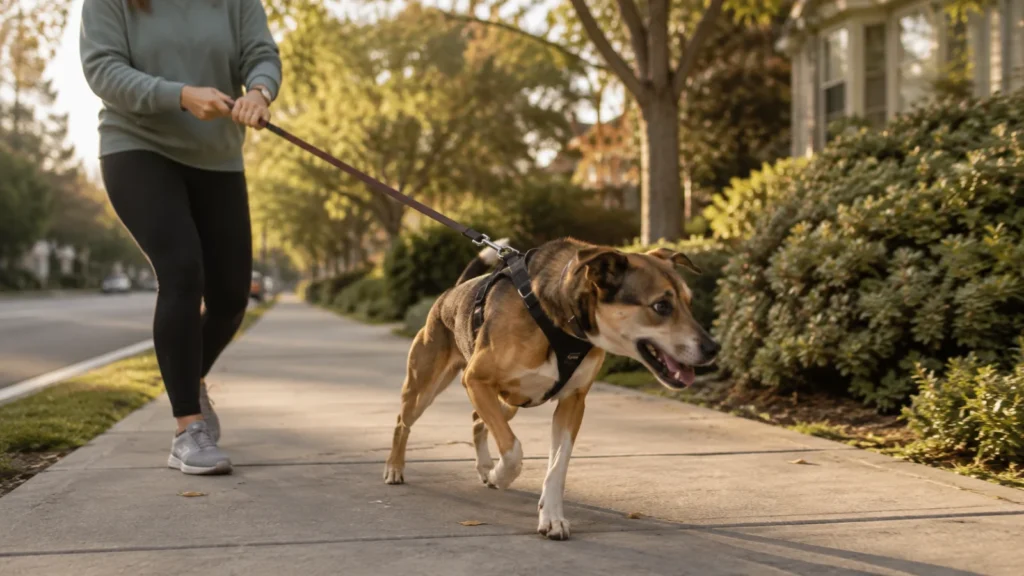
Most people assume a dog that pulls on the leash is being stubborn, dominant, or just badly trained. That assumption is understandable. It is also the reason so many owners spend months trying harder at the wrong thing.
Leash pulling is one of the most common frustrations we see across dog owners at every experience level, with every breed, every age. And the behavior almost never comes from what people think it does. Understanding why dogs pull on the leash, at the level of what is actually happening in the dog’s brain and body, changes everything about how you approach it.
This is not about having the right equipment or finding a magic command. It is about understanding what your dog is actually communicating before you try to change anything.
The Misconception That Makes Leash Pulling Worse
Walk into any pet store and you will find shelves of products designed to stop leash pulling through pressure, correction, or restriction. The underlying message is the same: the dog is doing something wrong, and the solution is to make that wrong thing uncomfortable.
That framing is where most owners get stuck. When you approach leash pulling as defiance, you are solving for the wrong problem. The dog is not pulling at you. In almost every case, the dog is pulling toward something, and that forward pull is completely logical from where they stand.
Treating pulling as a discipline issue tends to increase tension on both ends of the leash. The dog does not learn to walk calmly; it learns that walks are a conflict. That shift in association is genuinely hard to undo later, which is why starting with the right framework matters so much.
Why Dogs Pull on the Leash: What Is Actually Happening
Dogs move at a natural pace that is faster than most humans walk. Their sensory world on a walk is also dramatically richer than ours. Every patch of grass, fire hydrant, and passing stranger carries layers of information that are genuinely exciting and biologically compelling to process.
Pulling on the leash works, from the dog’s perspective. The moment tension builds in the leash and the owner follows forward, the dog has learned something: pulling gets me where I want to go. That single feedback loop, repeated over dozens and hundreds of walks, becomes deeply practiced behavior.
This is not a character flaw. It is straightforward learning. The dog did something, and it worked. So they do it again.
Research from animal behavior scientists and organizations like the American Veterinary Society of Animal Behavior consistently supports the understanding that dogs repeat behaviors that are reinforced, even when the reinforcement is simply forward movement. No treat required. The environment itself is the reward.
Five Reasons Dogs Pull (and Why One Answer Is Never Enough)
Leash pulling on its own is a symptom, not a diagnosis. The five patterns below cover most of what is actually driving it, and many dogs have more than one happening at once.
1. Arousal and excitement. For a dog that spends most of the day inside, stepping outside is the most stimulating part of their entire day. That spike in arousal before the walk even begins often sets the tone for everything that follows. The dog is already in a heightened state before the leash clicks on.
2. Sensory overload. Smells, sounds, movement, other animals. A dog’s nose is processing an enormous amount of information on every walk, and the pull toward a specific smell is often more about investigation than excitement. The dog wants to read the world, and the leash keeps interrupting.
3. Insufficient practice at a loose leash. Many owners underestimate how many repetitions it takes to build a new walking pattern. A dog that has been pulling since puppyhood has thousands of reinforced repetitions behind them. A few training sessions, even good ones, rarely outweigh that history quickly.
4. Inconsistent handling across people. If one person holds the leash loose and another lets the dog forge ahead, the dog learns that the rules shift depending on who is holding the leash. Inconsistency extends the learning timeline significantly.
5. Anxiety or reactivity beginning to surface. Some dogs that seem to be pulling for excitement are actually pulling because they feel unsettled and are trying to increase distance from something, or close it quickly. This pattern is easy to misread, and addressing it as a simple pulling problem without recognizing the underlying stress rarely helps.
Not sure which pattern fits your dog? Understanding the specific driver changes everything about your approach.
What Your Dog’s Pulling Is Trying to Tell You
Think about what a typical walk looks like when pulling is at its worst. The dog hits the end of the leash within seconds of leaving the door. They zigzag, nose to the ground, then lunge toward another dog or a person. You are bracing, adjusting your grip, maybe shortening the leash further. The whole walk feels like a negotiation you are losing.
In many cases like this, the issue is not disobedience. It is a dog that has never had the opportunity to learn that walking calmly on a leash is even an option. No one taught it. The environment rewards pulling, and nothing has meaningfully rewarded the alternative.
Every dog’s situation is slightly different, which is why generic advice about leash pulling only goes so far. A dog pulling because of excitement needs a different starting point than a dog pulling because of underlying anxiety. A dog that pulls with one family member but not another has a different problem to solve than a dog that pulls in every context.
If this sounds like your dog, get your dog’s personalized behavior breakdown and find out what is actually driving the pattern.
The One Thing Most Owners Do That Extends the Problem
The most common mistake owners make when dogs pull on the leash is continuing to walk forward anyway. It happens for completely understandable reasons: the walk needs to happen, there is limited time, it feels more exhausting to stop than to just keep going.
But every step forward while the leash is taut adds one more repetition to the behavior the dog is learning. Pulling on the leash is working. That lesson compounds over time.
The solution is not complicated, but it does require patience. When the leash goes tight, movement stops. The moment the dog checks in or releases the tension, movement resumes. Done consistently, across many walks, this teaches the dog that a loose leash is what keeps the walk going.
That said, consistency is genuinely hard when you are tired, running late, or managing two dogs and a coffee. This is not a judgment. It is just an honest acknowledgment of why this particular skill takes longer than most training guides suggest.
Tools That Help (and What They Cannot Do on Their Own)
Equipment can make the training process more manageable, but it does not do the training for you. A  rabbitgoo Dog Harness, No Pull for Large Dogs with 2 Leash Clips that redirects the dog’s forward momentum is a useful tool during the learning phase, particularly for dogs that are strong enough to put real strain on your shoulder. It gives you a safer starting position while you build the new pattern.
As an Amazon Associate, PrimeDoggy may earn from qualifying purchases.
A long line is valuable in a different way. It gives the dog the experience of making choices at a greater distance, including the choice to check back in with you, without the physical restriction of a standard leash. Many trainers use long lines as a bridge between controlled leash work and real-world reliability.
What neither of these tools can do is replace the underlying communication work. The ASPCA and other leading animal welfare organizations consistently note that equipment changes the mechanics of a walk; it does not change what the dog has learned to do. That part takes repetition, timing, and understanding what your specific dog responds to.
For more on building the right foundation for your dog’s behavior, the PrimeDoggy blog covers the principles behind calm walking in detail.
How Leash Pulling Can Grow Into Something Harder Over Time
Left unaddressed, leash pulling tends to evolve. A dog that pulls consistently through high-arousal moments on walks often begins scanning more intensely for those moments before they arrive. That anticipation builds over time into a state where the dog is already activated before any trigger appears.
For some dogs, pulling that starts as pure excitement gradually takes on elements of reactivity. The dog that used to pull toward other dogs out of enthusiasm begins to pull and vocalize, or pulls and lunges. The line between excitement and overstimulation gets thinner the more it is crossed.
This progression is not inevitable, and it is not a reason to panic. But it is a reason to take leash pulling seriously as a behavior pattern worth addressing now rather than waiting until it escalates. Most dogs that develop reactivity on leash had early signs that were manageable, and then those signs became practiced. Earlier is almost always easier.
What Calm Leash Walking Actually Requires
Calm leash walking is a trained skill, not a default. Dogs do not arrive knowing how to match a human’s pace and stay attentive to a person’s movement while an entire world of smells and sounds competes for their attention. That ability is built through repetition, clear feedback, and an environment where the dog can actually learn rather than just react.
Short sessions in low-distraction environments tend to produce faster results than long walks in busy areas where the dog is already over threshold. Starting in the backyard or on a quiet street gives the dog a real chance to practice the skill before they are asked to perform it somewhere genuinely challenging.
Reward timing matters more than most owners realize. The moment the leash is loose and the dog is in roughly the right position, that is the moment to mark and reward. Waiting until the dog has been walking calmly for thirty seconds means you have missed dozens of opportunities to reinforce the exact behavior you want.
Working with a certified trainer can shorten this learning curve considerably, especially for dogs where the pulling has been going on for a long time or where reactivity may be a factor. Professional help is not a last resort; it is a practical tool that experienced dog owners use all the time.
Recommended Next Step
Leash pulling rarely has one single cause. The pulling you are dealing with on your walks today could be rooted in arousal, anxiety, inconsistent reinforcement history, or some combination of all three. Generic advice about stopping and waiting, or switching to a different harness, addresses the surface without touching what is actually driving the behavior in your specific dog.
The Dog Wellness Profile is designed to cut through that. It takes the guesswork out of why your dog pulls on the leash and builds a starting plan around your dog’s actual pattern, not a one-size description of the problem. Used by dog owners working to build calmer routines every day, it is the most direct way to move from frustrated repetition to a walk that actually feels good for both of you.
Start your dog’s calm walking plan, free, instant, and built around your dog specifically.